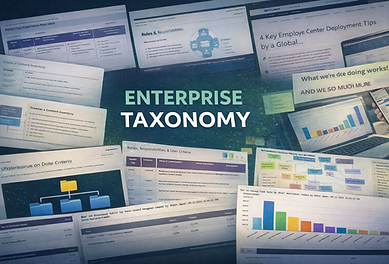
Enterprise Taxonomy Transformation
BiogenCONNECT | ServiceNow
When platforms grow organically, complexity compounds quietly.
BiogenCONNECT — built on ServiceNow and spanning multiple departments, applications, and integrations — had matured into a powerful ecosystem. But as content, catalog items, and tasks expanded, the underlying structure did not evolve with the same intentionality. Ownership blurred. Categories overlapped. Discoverability weakened. Personalization and AI search were constrained by fragmented architecture.
The opportunity was not cosmetic redesign. It was structural transformation.
The Challenge
Across thousands of requests and knowledge assets, employees were navigating a system shaped by organizational silos rather than user behavior. High-volume tasks were buried within inconsistent hierarchies. Search performance was impacted by inconsistent metadata. Governance lacked clarity, creating long-term sustainability risks. The platform worked, but it was not optimized for scale, AI-readiness, or intuitive discovery.
The data told the story
-
18,373 active requested items in the system
-
31.62% of requests were tied to account reactivation alone
-
22.58% were Virtual Desktop Requests
-
11.43% fell into “Other”
-
61.12% of catalog tasks were grouped as “Other” — a signal of categorization breakdown
This volume and ambiguity created friction:
-
Employees struggled to find what they needed.
-
Departments managed content in silos.
-
Personalization and AI search couldn’t fully perform because the underlying structure wasn’t optimized.
To modernize Employee Center, the foundation had to be rebuilt.
My Role
As Lead UX Content Strategist and Enterprise Taxonomy Consultant, I led the end-to-end transformation — from discovery through validation and governance modeling. The methodology and deployment approach were later highlighted by ServiceNow in their Employee Center Show & Tell as a model for successful implementation.
Discovery
Conducting a comprehensive content inventory, audit, and performance analysis across knowledge articles, catalog items, and task records to identify redundancies, structural gaps, and high-volume friction points
Governance Model
Structuring governance roles and decision models to sustain long-term integrity
Workshops
Leading executive and stakeholder alignment sessions
Implementation
Connecting knowledge, catalog, and task content into a cohesive, scalable system aligned to personalization and AI-search optimization
Design
Designing the unified enterprise taxonomy framework
Reporting
Establishing trackable reporting frameworks leveraging ServiceNow Performance Analytics and UX Analytics to monitor taxonomy impact over time
KPIs
Defining UX success metrics and KPIs to measure discoverability, task completion, search effectiveness, and adoption
User Validation
Designing and facilitating usability testing to validate clarity, navigation flow, and task completion
My Approach
1. Diagnose the System
I began by quantifying complexity. Through content inventories, request volume analysis, catalog audits, and search behavior review, we surfaced structural breakdowns and high-friction categories. This diagnostic phase revealed where discoverability failed and where personalization logic was constrained.
2. Design the Framework
Using behavioral insights and cross-functional input, I restructured the taxonomy to reflect how employees think about their work — not how departments were organized internally.
-
Clarified parent-child topic relationships
-
Standardized metadata structures
-
Aligned homepage, mega menu, and quick links to the new hierarchy
-
Connected catalog items, knowledge articles, and tasks within a unified model
This created a scalable, AI-supportive information architecture designed for personalization and search optimization.
3. Validate with Real users
Taxonomy is only successful if it works in practice. I designed and facilitated usability validation to test:
-
Topic clarity
-
Navigation flow
-
Search effectiveness
-
Task completion success
Feedback directly informed structural refinements prior to deployment. The result was a framework shaped not by assumption, but by observable user behavior.
4. Operationalize & Sustain
Enterprise taxonomy fails without governance. I worked with the client to formalize roles, responsibilities, and maintenance workflows to ensure long-term sustainability. Decision frameworks were defined to prevent structural erosion as new content scaled.
The Impact
This transformation did more than reorganize content. Most notably, the approach was showcased by ServiceNow as a deployment success story, validating the methodology and elevating taxonomy from backend structure to strategic experience architecture.
-
Stronger AI-driven search accuracy
-
Improved personalization logic
-
Reduced navigation friction in high-volume categories
-
Clear ownership and governance across departments
-
Greater executive confidence in ServiceNow scalability